Have you ever wonder why the name "Krokodil" for a drug.
Well, "Krokodil" is the Russia street name of the drug called
Desomorphine(medical name). The drug was first synthesized in US in 1932 and
patented on November 13,1934. It was use in Switzerland under the brand name
Permonid, it was previously use for treatment of severe pain (on person with
rare illness) and its uses was terminated in the year 1981. In
1981,Desomorphine was decleared an illegal narcotic analgesic (a pain-relieving
drug).
Krokodil was first
used in Russia in 2003, according to the Journal of Addictive Disease. Its
abuse in Russia attracted international attention in 2010 due to increase in
clandestine production, presumably due to its relatively simple synthesis from
codeine containing drugs available over- the- counter (OTC).
WHY IS IT CALLED KROKODIL?
Krokodil gets
its name from the fact that the caustic drug causes an addict's skin to become
green, scally and bumpy like a crocodile's. This happened when the drug misses
a vein and is injected into the flesh, the flesh will develop abscesses. It is
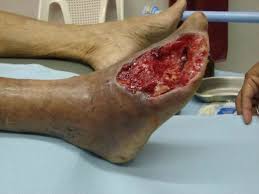
common for addicts to develope gangrene and require amputations. The flesh on
some body parts affected by Krokodil injections will rot off completely,
leaving bare bone, hence it is also refer to "flesh- eating drug"
that turns people into Zombie- like creatures.
LOCAL MANUFACTURE OF KROKODIL
Krokodil is
made at home by acquiring codeine, sold over- the- counter (OTC) and cooking it
with paint thinner, gasoline and red phosphorus from matchbox Strike pads (
safety matches). The resulting liquid is them extracted and injected into the
vein.
HARMFUL EFFECT OF KROKODIL
When
Krokodil is injected intravenously, the effects can be felt within seconds to
minutes. The effects is as follows:
Ø euphoria [excited happiness or high (slang) which normally lasts
90 minutes to two hours].
Ø Skin discoloration
Ø bone infection
Ø liver and kidney problems
psychological dependency , which can lead to death.
SIGNS OF KROKODIL ADDICTS
The visible signs with
Krokodil addicts are
Ø Lesion and necrosis ( death of cells in the body)
Ø decayed facial bones or rotting ears, noses and lips , as show
below.Have you ever wonder why the name "Krokodil" for a drug.
Well, "Krokodil" is the Russia street name of the drug called
Desomorphine(medical name). The drug was first synthesized in US in 1932 and
patented on November 13,1934. It was use in Switzerland under the brand name
Permonid, it was previously use for treatment of severe pain (on person with
rare illness) and its uses was terminated in the year 1981. In
1981,Desomorphine was decleared an illegal narcotic analgesic (a pain-relieving
drug).
Krokodil was first
used in Russia in 2003, according to the Journal of Addictive Disease. Its
abuse in Russia attracted international attention in 2010 due to increase in
clandestine production, presumably due to its relatively simple synthesis from
codeine containing drugs available over- the- counter (OTC).
WHY IS IT CALLED KROKODIL?
Krokodil gets
its name from the fact that the caustic drug causes an addict's skin to become
green, scally and bumpy like a crocodile's. This happened when the drug misses
a vein and is injected into the flesh, the flesh will develop abscesses. It is
common for addicts to develope gangrene and require amputations. The flesh on
some body parts affected by Krokodil injections will rot off completely,
leaving bare bone, hence it is also refer to "flesh- eating drug"
that turns people into Zombie- like creatures.
LOCAL MANUFACTURE OF KROKODIL
Krokodil is
made at home by acquiring codeine, sold over- the- counter (OTC) and cooking it
with paint thinner, gasoline and red phosphorus from matchbox Strike pads (
safety matches). The resulting liquid is them extracted and injected into the
vein.
HARMFUL EFFECT OF KROKODIL
When
Krokodil is injected intravenously, the effects can be felt within seconds to
minutes. The effects is as follows:
Ø euphoria [excited happiness or high (slang) which normally lasts
90 minutes to two hours].
Ø Skin discoloration
Ø bone infection
Ø liver and kidney problems
psychological dependency , which can lead to death.
SIGNS OF KROKODIL ADDICTS
The visible signs with
Krokodil addicts are
Ø Lesion and necrosis ( death of cells in the body)
Ø decayed facial bones or rotting ears, noses and lips , as show
below.
Krokodil is a dangerous drug, with life
expectancy of the users / addicts, is just a year or two. According to doctors
dealing with addicts, Krokodil addict is much worse than heroin and it is the
strongest level of addiction and the hardest to cure. If a person does manage
to get clean from krokodil, they may be left with impediment, vacent gaze and
erratic movement.
I think with education using leaflets, mass
media and with synergy of organizations like NDLEA, UNODC,NIDA etc , the menace
of Krokodil
and others abuse substances like cocaine, heroine etc will be reduce
to the bearest minimal.